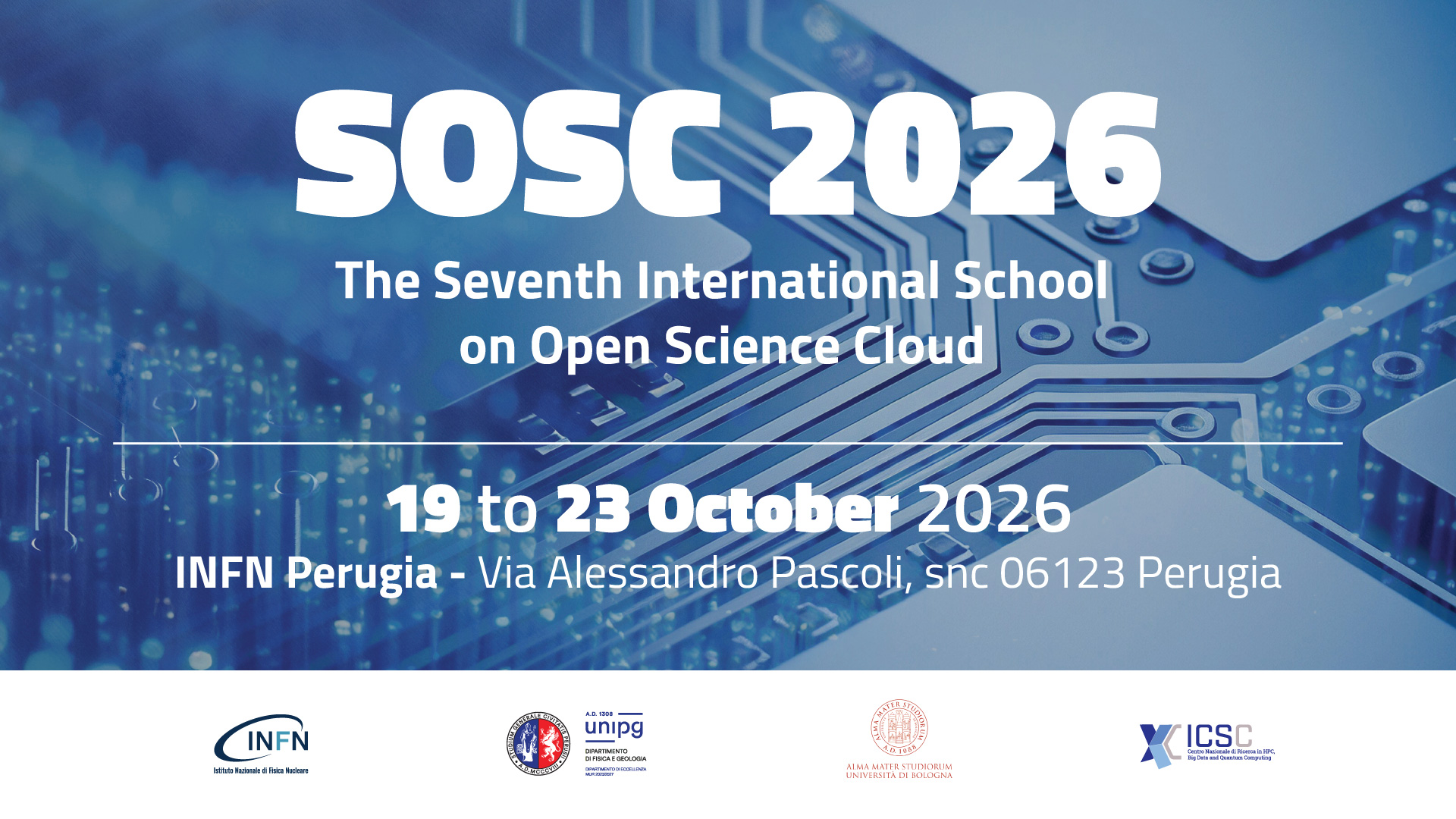
Abstract
Course details
The School is multi-disciplinary and is targeted at postgraduate participants, including researchers, technologists, and professionals from industry or private companies, holding a master’s degree or equivalent in fields such as physics, statistics, computer science, computer vision, biology, medicine, bioinformatics, engineering, or related disciplines.
Applicants may be working at any research institutes, universities, public bodies, or private companies, and should have some experience and a strong interest in data analysis, computing or related fields.
Applications by university undergraduate students will also be considered, depending on availability, and must be accompanied by a letter of reference from a university professor.
We embrace diversity and strongly encourage qualified and curious individuals from all nationalities and backgrounds to apply.
Programme
Fundamentals
- Computing Models in distributed systems
- Resource exploitation across Cloud, HPC and Edge environments
- Heterogeneous computing: GPU and FPGA-equipped providers
Data Science
- Introduction to Machine Learning concepts
- Deep Learning essentials, applications and tools
- AI workloads on distributed and heterogeneous platforms
Distributed Applications
- Construction of scalable and reproducible computing pipelines
- Remote and distributed inference for data‑intensive workloads
Learning outcomes
- Understand computing models and architectures in distributed systems (Cloud, HPC, Edge).
- Effectively use heterogeneous computing resources (CPU, GPU, FPGA).
- Apply basic Machine Learning and Deep Learning techniques to real-world problems.
- Execute and optimize AI workloads on distributed platforms.
- Design scalable and reproducible computing pipelines.
- Develop distributed inference solutions for data‑intensive workloads.
Prerequisites
Prerequisites for the hands-on sessions include:
- basic knowledge of NumPy, Pandas and Matplotlib.
- Familiarity with commonly used ML/DL frameworks and libraries such as scikit-learn, Tensorflow, Pytorch is expected.
Knowledge of containerization and orchestration technologies (e.g. Docker, Docker-compose, Kubernetes) and cloud or object storage systems (e.g. S3-compatible storage) is considered a plus.
Teaching methods
- Lectures
- Hands-on.
Certificate
An attendance certificate will be provided to the students attending the whole school programme. The school will also issue an official “SOSC School of Computing Diploma’ upon successful completion of a project that will be assigned during the school.
Registration
The registration fee includes:
- morning & afternoon coffee breaks
- social dinner and participation in the welcome event.
The final application deadline for registration is September 18, 2026.
Accommodation and transfers to and from the school venue are not included in the registration fee. Meals are not included, unless explicitly provided as part of school events.
The registration fee is €250 and fee payment will open on October 2nd, 2026.
