
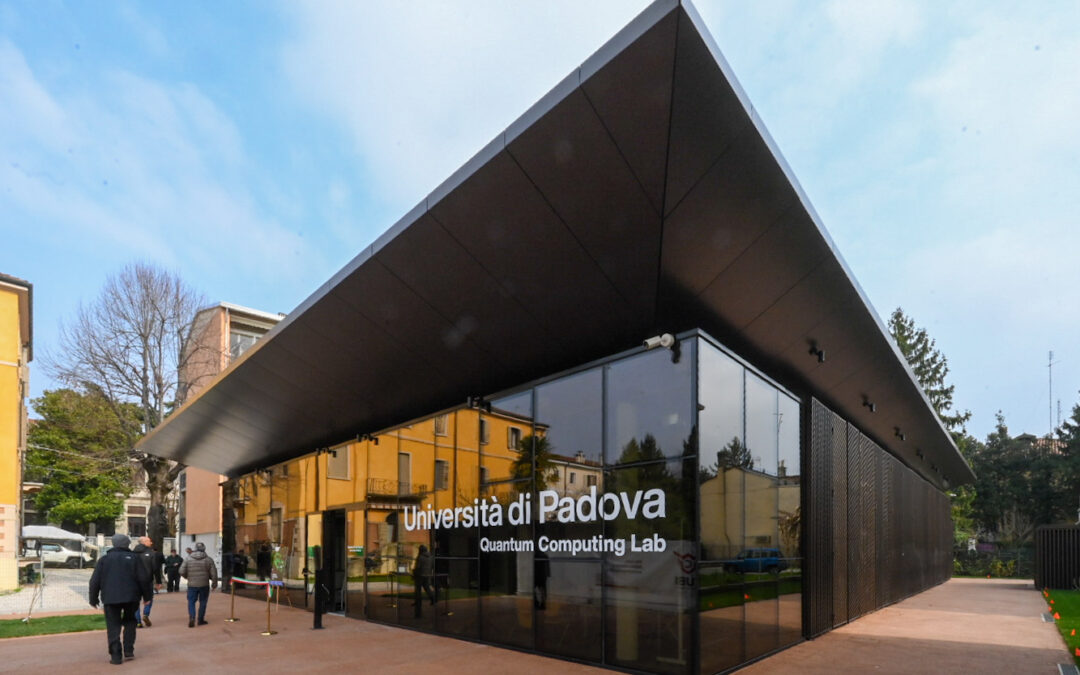
In the presence of the Rector of the University of Padua, Daniela Mapelli, the Councillor of the Municipality of Padua, Francesca Benciolini, and the President of the Veneto Region, Alberto Stefani, the Quantum Computing Lab was inaugurated today, Monday, March 2. The new University facility, located on Via Luzzati in Padua, houses spaces designed for activities involving trapped-ion quantum computers, physics of the Universe, lasers and optics, and other laboratories.
The Quantum Computing Lab represents a strategic investment in infrastructure and equipment. The laboratory will host the development of a quantum computer built using trapped-ion technology. The initiative is part of the QCSC project funded under the WCRI call, which is developing a complete quantum computing ecosystem (hardware, software, and their scientific and industrial applications), and exploring the interface between quantum computing and quantum communications. The project involves twelve Departments of the University of Padua and the Interdepartmental Center for Quantum Technologies, Padua QTech. The activities of the Quantum Computing Lab have also been supported by the ICSC – Italian Research Center on HPC, Big Data and Quantum Computing, thus contributing to the coordinated development of the Italian quantum computing ecosystem.
The program also involves several other Italian universities (Pavia, L’Aquila, Naples and Bologna…) together with a network of high-level institutions and partners, including Cineca, INFN Q@TN, TQT, NEAT, ARAKNE, and ALGORITHMS. This highlights the strongly interdisciplinary nature and the national and international scope of the initiative, which has also led to the establishment of the Italian Quantum Alliance, an association representing institutions and companies active in quantum technologies in Italy, headquartered in Padua.
The University of Padua’s strong commitment to quantum technologies also aims to contribute to the development of the Italian Strategy for Quantum Technologies and the European Quantum Strategy.
“The investment in the Quantum Computing Lab, approximately five million euros for construction alone, represents one of the most significant efforts made by our University to provide research with adequate spaces,” stated Rector Daniela Mapelli. “This figure is noteworthy not for its economic size, but for what it represents: the awareness that excellent research requires excellent infrastructure. A laboratory is not simply a container; it is an accelerator of ideas, a place that enables collaboration, an environment that makes possible what was previously impossible. Quantum technologies will indeed have a decisive impact. However, every scientific advancement carries responsibility. Our tradition, rooted in centuries of freedom of research and thought, reminds us that the role of academia is not only to produce knowledge, but to direct it toward purposes that strengthen human dignity and social cohesion. In this sense, quantum is not only a technological challenge; it is a test of our ability to govern innovation with responsibility and foresight.”
“Research and critical thinking have always characterized the city of Padua,” added Francesca Benciolini, Councillor of the Municipality of Padua. “Investments like this in research infrastructure allow our city to be enriched by people capable of embracing scientific challenges, enabling our community to feel actively involved in innovation processes.”
“With this initiative,” emphasized the President of the Veneto Region, Alberto Stefani, “the University of Padua takes a highly significant step into modernity, looks to the future, and aims to build it through research, in an environment characterized by advanced laboratories, high technology, and education. This University investment creates an innovation context at the highest levels. This is what our young people need to grow professionally, and what Veneto’s entrepreneurship needs, as innovation becomes its guiding star.”
The Quantum Computing Lab
A trapped-ion quantum computer is a platform in which quantum information is “written” and manipulated using ions (electrically charged atoms) that are suspended and confined by electromagnetic fields inside a trap. The ions are controlled with extreme precision through pulses—especially lasers—which make it possible to prepare, evolve, and read quantum states. This technology is considered among the most promising for building stable and controllable quantum processors, suitable for exploring new applications in the simulation of complex systems, optimization, and the development of quantum algorithms.
The total cost of the project, including asbestos remediation works, amounts to €4,800,000. The scientific instrumentation installed totals approximately €4,500,000, of which €3,500,000 comes from WCRI funding and €1,000,000 from the PNRR – National Center 1, Spoke 10.
The WCRI project was funded through a call issued by the University of Padua, which allocated €7.5 million to promote the acquisition of “World Class Research Infrastructures” (WCRI): highly innovative research infrastructures of scientific excellence capable of serving as international reference points. Thanks to this investment, the University accelerates the development of technological platforms that provide the scientific community with resources and services for cutting-edge research and innovation.
Spaces and Technical Requirements for Advanced Research
The building covers a gross floor area of 683.0 m², distributed between the ground floor (laboratories, 565.4 m²) and the first floor (technical rooms, 117.6 m²). The net laboratory area amounts to 386.9 m², organized into specialized areas:
- Quantum Computer Laboratory: 104.1 m², with a dedicated control room (34.1 m²);
- Physics of the Universe Laboratory: two rooms of 77.9 m² and 15.1 m²;
- Laser Laboratory: 17.0 m²;
- Modular laboratories: 7 rooms ranging from 15.3 m² to 23.0 m².
The facility also includes a 26.8 m² meeting room and dedicated technical spaces (12.1 m² on the ground floor and 100.2 m² on the roof level).
Special attention has been given to the requirements of highly sensitive equipment: a 213.60 m² isolated slab with anti-vibration joint has been designed specifically to guarantee optimal operating conditions for the quantum computer.
From an energy and systems perspective, the building integrates a 30 kW photovoltaic system (62 panels) and a geothermal cooling system dedicated to the machinery, with one 137 m intake well and two 137 m discharge wells (authorized and scheduled for execution). Advanced systems are also installed, including technical gases, electrical distribution with busbar trunking and UPS, oxygen level detection, and a safety control system for operating lasers. A dedicated 250 kW medium-voltage/low-voltage (MV–LV) substation serves the facility.
“The new structure incorporates extremely stringent technical requirements, from anti-vibration features to support systems, to host frontier instrumentation,” concluded Flavio Seno, Director of the Department of Physics and Astronomy at the University of Padua. “It is a laboratory designed not only for research, but also for education: here students will develop advanced technological skills and experience science ‘in the field,’ in close contact with next-generation experimental equipment and methods.”
“The development of a trapped-ion quantum computer and the activities of the Quantum Computing and Simulation Center (QCSC) are based on a broad interdisciplinary network involving numerous Departments, Padua QTech, and leading national and international scientific and industrial partners,” explains Simone Montangero, Director of the Quantum Computing and Simulation Center and co-leader of ICSC Italian Reserch Center quantum computing activities. “The goal is to build a platform that enables cutting-edge research and innovation, with significant scientific and educational impact.”
More information: https://www.unipd.it/news/inaugurated-padua-new-quantum-computing-lab